


Hotel Marketing: How Hotels Can Automate Their Email Marketing

Contents
Segment your Leads into Different Lists and Campaigns
Automate your Email Marketing Workflows
Start Using Responsive Email Templates
Use Automation Rules to Avoid Spamming Uninterested Contacts
Automate Tracking and Reporting
In the post-COVID era, the hospitality industry is enjoying a reinvigorated flow of business, and hotels worldwide are ramping up their marketing efforts to compete for guests.
With such a competitive business arena, every aspect of your marketing strategy needs to be as efficient and well-aligned as possible to keep it competitive and put your materials in front of the right people.
In this post, we’ll take a closer look at email marketing and how hotels can automate it to run more efficient, effective campaigns.
Segment your Leads into Different Lists and Campaigns
Like most hotels, yours probably attracts a wide variety of guests, and different types respond to different kinds of marketing content. Some may jump at every promotion in your calendar. In contrast, others will ignore the special offers and discounts and prefer to browse content on the best things to do in particular destinations.
By segmenting your leads into different subscriber lists, you’ll make it much easier to tailor your messaging to the right sub-section of your audience, taking the manual work out of targeted marketing, and enjoying higher overall returns from your email campaigns.
Once you make audience segmentation a constant in your email marketing, you’ll also be able to lead score effectively and make sure that your future marketing drives are focused on the most valuable kinds of potential guests. According to leading sales software provider Sopro, lead scoring better equips you to “monitor the fruits of your segmentation strategy, as your increasingly targeted marketing brings in more relevant prospects”.

Automate your Email Marketing Workflows
Once you have a better idea of who your leads are and what sets each segment apart, the next step is to automate your email workflows so they account for those differences.
If, for example, you send out an email telling your audience about a new hotel branch that’s opening, and some of your recipients click a “download brochure” button from your email, this might move those people into a segment that has shown interest in the new branch. If people from that branch fail to make a booking at that hotel within a specific period of time, this could trigger a follow-up email highlighting some distinctive features about the new hotel.
These kinds of rule-based automated workflows will further ensure that various segments of your audience receive the right messaging and remove much of the manual work of crafting new messaging for new segments.
Start Using Responsive Email Templates
One of the most powerful email automation tools on the modern market is responsive email templates.
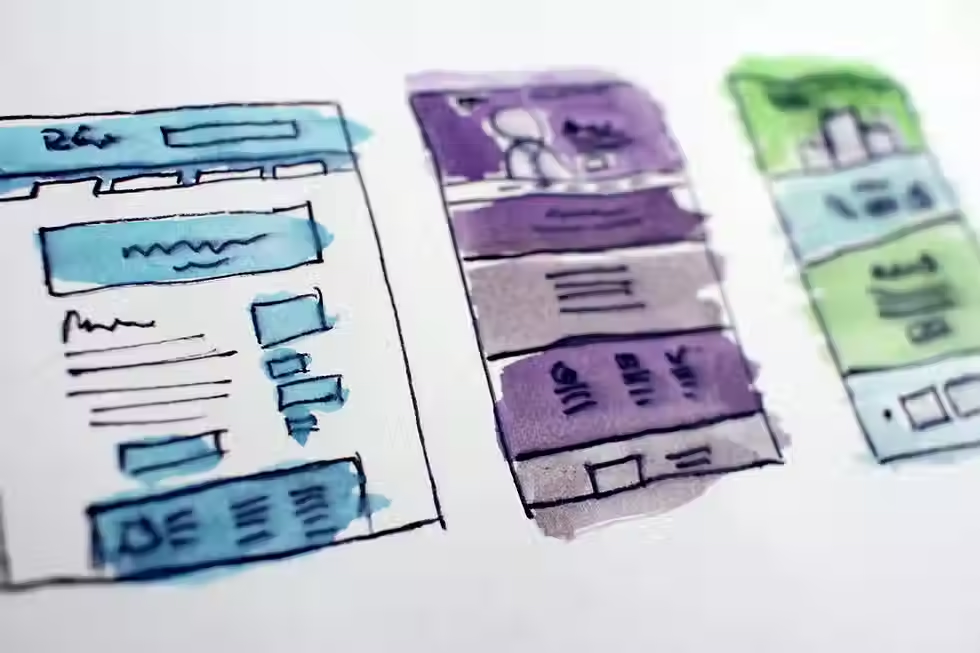
Like any content, the way your marketing emails appear to your audience will significantly influence their success. Responsive email templates allow you to customise your email content to display correctly on the recipient’s device, while allowing you to design the content from a single platform.
This method of email automation has proven highly effective in terms of marketing ROI across many business segments. For example, when job board CareerBuilder switched to responsive email, they saw a 21%-24% increase in click-through and a 15%-17% improvement in open rates.
Because travel planning and hotel browsing are activities many people do in their downtime, it’s especially important for hotels to ensure their marketing materials display correctly on any device used to view them.
Use Automation Rules to Avoid Spamming Uninterested Contacts
Almost everyone knows what it’s like to have an out-of-control inbox. After clicking “accept” on one too many pop-ups, an inbox can quickly become flooded with emails from countless different campaigns, many of which you’ll have no intention of opening. Your potential guests are the same, and the last thing they’ll want is another email added to the pile that doesn’t offer real value.
As you already know, a person getting into your contact list doesn’t necessarily mean they’re on the verge of booking a room at your hotel. They may have shared their email during a session of idle window-shopping while researching travel plans for a particular place, or signed up through an offer from a business with which you have a partnership. This doesn’t mean that you should drop those contacts immediately - it simply means that you should temper the way you market to them.
To avoid alienating your contacts, you can create email automation rules that will re-categorise contacts so that you stop spamming them and risk making them hostile to your brand. If, for example, you email a particular contact three times and all three emails go unopened, you might want to move this address to a “cold” audience segment to prevent further campaigns from being sent to them.
After a predetermined period of time or another trigger indicating renewed interest, you can start emailing your contact again, hopefully in a context more conducive to securing a booking!
Automate Tracking and Reporting
Although modern email automation has some pretty impressive capabilities, it hasn’t put marketers out of a job completely yet, and you’ll still need to make manual observations and decisions to keep your email marketing as effective as possible.
With the right tools, you can take a lot of the work out of tracking and reporting on your customer behaviour, and keep your team well-equipped with a steady stream of valuable insights.
Many of the automation strategies we’ve listed here will require a modern email marketing tool to facilitate. This software typically also comes with a suite of sophisticated analysis tools, allowing you to see how your campaigns are being received and automatically generate reports that highlight where your campaigns could use improvement.
With access to these features, you’ll be able to consolidate a range of valuable data sets in detailed reports, and continuously test the effectiveness of your campaigns for a relatively small recurring overhead.


Comments